
Product Overview: Gotrays® Cu-Ion Series
The Gotrays® Cu-Ion Series stands as a premier high-performance inorganic antimicrobial additive designed to elevate industrial hygiene standards. Engineered with advanced material science, this series harnesses the power of active copper ions (Cu²⁺) to provide broad-spectrum defense against pathogens. Unlike temporary surface treatments, our solution integrates directly into the substrate matrix, delivering permanent protection that remains effective throughout the product’s entire lifecycle.
Our copper-based bacteriostatic agent is formulated to withstand rigorous processing conditions while maintaining absolute efficacy. It serves as a critical component for manufacturers seeking to enhance product value and safety across global markets.
Key Application Sectors
We deliver specialized antimicrobial solutions tailored for high-demand industries:
- Textiles: Durable protection for sportswear, medical fabrics, and functional fibers.
- Plastics: High-stability additives for injection molding and extrusion in electronics and automotive parts.
- Coatings: Advanced formulations for paints, epoxy flooring, and public infrastructure.
- Medical Devices: Essential hygiene control for equipment surfaces and healthcare environments.
Key Features & Benefits of Gotrays Copper Ion
When we developed the Gotrays® series, our goal was to solve the limitations of traditional organic agents. We utilize a high-temperature antibacterial additive that integrates seamlessly into your production line without slowing you down. By leveraging the natural power of copper, we provide a solution that is tough on pathogens but safe for end-users.
Superior Performance and Stability
Our inorganic antimicrobial additive is engineered for resilience. Unlike organic alternatives that break down under heat, our formula maintains stability up to 320°C. This makes it the go-to choice for processing engineering plastics like PET, PA, and PC via injection molding. You don’t have to worry about discoloration or loss of efficacy during high-heat manufacturing.
- Broad-Spectrum Protection: We achieve >99.9% reduction rates (Log 3) against a wide range of bacteria, fungi, and viruses, fully meeting ISO 22196 compliant additive standards and JIS Z 2801 protocols.
- Permanent Efficacy: As a non-migrating copper-based bacteriostatic agent, the active ingredients lock into the material matrix. The protection lasts for the product’s entire lifecycle and does not wash away.
- Cost-Effective Efficiency: We offer a significant economic advantage over silver (Ag) ion agents. You get powerful antimicrobial action at a fraction of the cost, improving your margins.
- Safety First: The profile is non-toxic, non-irritating, and free from VOCs, ensuring compliance for consumer-facing applications.
Technical Performance
| Feature | Specification | Benefit |
|---|---|---|
| Thermal Stability | ≥ 320°C | Ideal for high-heat injection molding (PET, PA, PC). |
| Efficacy | >99.9% (Log 3) | Reliable protection against bacteria and mold. |
| Composition | Inorganic Copper | Non-migrating, long-lasting durability. |
| Safety | VOC-free | Safe for human contact and environmentally friendly. |
We ensure that integrating our Cu2+ antibacterial powder adds value to your product without complicating your manufacturing process.
Mechanism of Action: The Science Behind the Cure
When we talk about the efficacy of our Copper Ion Antibacterial Agent, we are looking at a multi-stage attack on pathogens. Unlike organic agents that might degrade over time, our inorganic antimicrobial additive functions through a physical and chemical process that bacteria cannot develop resistance to. The power lies in the active Cu2+ antibacterial powder, which creates a hostile environment for microbes the moment they make contact with the treated surface.
Here is the breakdown of the “Contact Killing” process that makes our technology so effective:
- Electrostatic Attraction: Bacteria typically possess cell walls with a negative charge. Our copper ions (Cu2+) carry a strong positive charge. This difference creates a powerful electrostatic attraction, pulling the bacteria directly onto the surface of the material like a magnet.
- Membrane Disruption: Once attached, the copper ions penetrate the bacterial cell wall. This physical breach disrupts the structural integrity of the microbe, causing essential nutrients to leak out and the cell to collapse. This is a critical step in our broad-spectrum antimicrobial technology.
- Oxidation & DNA Damage: Inside the cell, the copper ions trigger the generation of Reactive Oxygen Species (ROS). These highly reactive molecules attack the bacterial DNA and enzymes, effectively shutting down metabolic processes. This ensures the bacteria are not just stopped, but destroyed, preventing any chance of reproduction or mutation.
Technical Data & Specifications
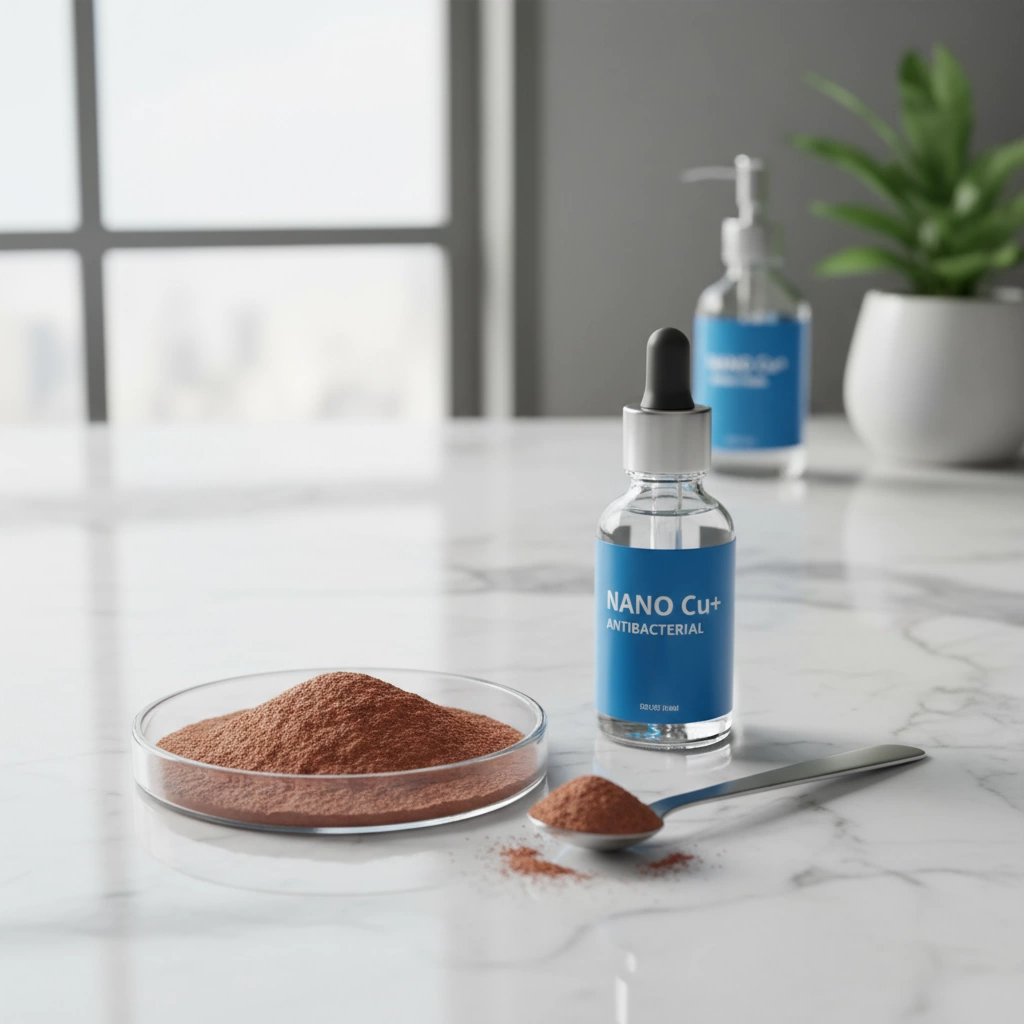
At Hipleastic, we engineer our Copper Ion Antibacterial Agent to meet rigorous industrial standards. As a high-temperature antibacterial additive, it survives processing conditions that typically degrade organic alternatives. We ensure our inorganic antimicrobial additive integrates seamlessly into your existing production lines without altering the material’s physical integrity.
Below is the technical profile for our standard Cu2+ antibacterial powder:
| Parameter | Specification |
|---|---|
| Appearance | Light Blue / Off-White Powder |
| Active Ingredient | Inorganic Copper Complex (Cu²⁺) |
| Particle Size (D50) | < 2.0 μm (Nano-grade options available) |
| Thermal Stability | ≥ 320°C |
| Moisture Content | ≤ 0.5% |
| pH Value | 6.0 – 8.0 (Neutral) |
| Recommended Dosage | 0.5% – 2.0% (by weight) |
Key Performance Indicators
- Superior Heat Resistance: With stability up to 320°C, this agent is ideal for injection molding and extrusion of engineering plastics like Nylon (PA), Polycarbonate (PC), and PET.
- Uniform Dispersion: The micro-fine particle size ensures the antimicrobial masterbatch for plastics mixes evenly, preventing surface agglomeration or mechanical weakness.
- Cost-Effective Efficiency: You achieve potent biological protection with a low addition rate between 0.5% and 2.0%, making it a viable solution for mass production.
Applications & Processing Guide: Copper Ion Antibacterial Agent
We have engineered our Copper Ion Antibacterial Agent to be a versatile workhorse across multiple manufacturing sectors. Our goal is to ensure that integrating high-level hygiene protection doesn’t require you to overhaul your existing production lines. Whether you are working with thermoplastics or functional fabrics, this inorganic antimicrobial additive delivers consistent performance without compromising material integrity.
Plastic Industry: Masterbatch & Direct Addition
Our antimicrobial masterbatch for plastics is designed for seamless compatibility with a wide range of resins, including PP, PE, ABS, PVC, PET, and PA. Thanks to the superior thermal stability of our Gotrays® Cu-Ion Series, the active ingredients withstand processing temperatures up to 320°C. This makes it ideal for injection molding and extrusion processes where organic additives would typically degrade.
- Ease of Dispersion: The micro-fine particle size ensures the agent spreads evenly throughout the matrix, preventing agglomeration.
- Processing Note: To ensure the best surface finish and mechanical properties, we recommend pre-drying the base resin and the additive to remove moisture before processing.
Textile Industry: Fiber Grade Compatibility
For manufacturers producing functional textiles, our copper ion textile finishing agent offers a distinct advantage over temporary surface treatments. It is compatible with synthetic fibers like Polyester, Nylon, and Acrylic, embedding the antimicrobial power directly into the yarn.
- Long-Term Durability: Because the copper ions are locked into the fiber structure, the fabric retains its efficacy even after 50+ industrial wash cycles. This is critical for sportswear and medical textiles that undergo frequent cleaning.
Coatings & Paints
We also formulate this technology as an antibacterial dispersion for coatings. It mixes easily into epoxy flooring, architectural paints, and industrial coatings. This application is essential for creating self-sanitizing surfaces in high-traffic areas like hospital walls, public transport interiors, and food processing facilities.
Comparative Analysis: Copper Ion vs. Silver Ion Antibacterial
At Hipleastic, we engineer solutions using both metals, but for many industrial applications, our Copper Ion Antibacterial Agent offers distinct technical and commercial advantages. While silver has long been the standard, copper is rapidly becoming the preferred choice for manufacturers looking for robust performance and better margins. Here is how they compare.
Superior Anti-Fungal and Anti-Mold Performance
Silver is excellent against bacteria, but copper is a true powerhouse against fungi and molds. Our fungicidal copper agent delivers a broader spectrum of protection. If your product operates in humid environments—such as bathroom accessories, outdoor textiles, or filtration systems—copper provides superior defense against the mildew and fungal growth that silver often misses.
Economic Benefits and Cost Reduction
The economics are straightforward: silver is a precious metal, while copper is an industrial staple. By switching to a copper-based bacteriostatic agent, you can significantly reduce raw material costs without sacrificing efficacy. This makes our inorganic antimicrobial additive the most cost-effective solution for high-volume production runs where keeping the unit price low is essential.
High-Speed Antiviral Action
In the fight against pathogens, reaction time matters. Our antiviral copper additive is engineered for rapid response. The active copper ions (Cu2+) often demonstrate a faster “kill rate” upon contact compared to silver, aggressively disrupting viral envelopes and bacterial cell walls. This high-speed action is critical for public touch surfaces and medical equipment.
Color Management: Handling the Blue Tint
One technical distinction is visual. Silver is generally colorless, whereas copper ions naturally possess a blue hue.
- Opaque Applications: In colored or white plastics, this tint is easily masked and does not affect the final look.
- Transparent Materials: In clear plastics like PC or PET, a subtle blue tint may occur. We have optimized our copper ion vs. silver ion antibacterial formulations to minimize haze, and many clients now utilize this unique tint as a visual marker to prove the presence of active antimicrobial technology.
Quality Assurance & Compliance Standards
When we supply our Copper Ion Antibacterial Agent, we understand that regulatory compliance is just as critical as antimicrobial performance. We ensure our additives meet strict international safety and environmental benchmarks, making them safe for use in consumer goods, medical devices, and industrial applications globally. We are committed to delivering a solution that is not only effective but also responsible.
Global Certifications and Safety
We prioritize safety and sustainability in our manufacturing process. Our copper-based solutions are designed to align with major regulatory frameworks to facilitate your product’s entry into global markets:
- REACH & RoHS: Our formulations are compliant with strict EU standards, ensuring they are free from restricted hazardous substances.
- FDA/EPA Guidelines: We formulate our additives to meet the rigorous safety requirements necessary for food-contact and healthcare applications.
Rigorous Testing Standards
To guarantee efficacy, we don’t just guess; we test. Our ISO 22196 compliant additive undergoes stringent evaluation to prove its ability to inhibit bacterial growth effectively.
- For Plastics (JIS Z 2801 / ISO 22196): We verify a reduction rate of >99.9% against common pathogens like E. coli and Staphylococcus aureus.
- For Textiles (AATCC 100): Our agents are tested to ensure they withstand industrial washing while maintaining high antimicrobial activity.
Third-Party Laboratory Support
We believe in total transparency. Beyond our internal quality control, we support third-party laboratory testing to validate performance for your specific end-products. Whether you need data for marketing claims or regulatory submission, we assist in navigating the testing process to ensure your products meet the highest hygiene standards.
Frequently Asked Questions (FAQ)
Will this agent change the color of my white plastic product?
Our Copper Ion Antibacterial Agent is designed to have minimal impact on the visual properties of your final product. The raw inorganic antimicrobial additive appears as a light blue or off-white powder. In most white or colored plastic applications, it blends seamlessly without altering the intended shade. However, for transparent or ultra-clear materials, a very faint blue tint might be visible depending on the dosage used. We recommend testing a small sample if optical clarity is critical for your application.
What is the shelf life of the powder?
Because our product utilizes a stable inorganic copper complex, it offers excellent longevity compared to organic alternatives. When stored correctly in a cool, dry environment and kept sealed to prevent moisture absorption, the powder maintains its efficacy for an extended period. The active Cu2+ antibacterial powder does not degrade over time under normal storage conditions, ensuring that your inventory remains ready for production whenever you need it.
Can I blend this with other additives like UV stabilizers?
Yes, you can. One of the biggest advantages of our Gotrays® Cu-Ion Series is its chemical stability. It is fully compatible with common industrial additives, including UV stabilizers, flame retardants, and glass fibers. Whether you are creating an antimicrobial masterbatch for plastics or a direct compound, our agent does not interfere with the performance of other functional ingredients. We always advise running a pilot test to confirm the dispersion and flow properties within your specific formulation.
Reviews
There are no reviews yet.